Our Process
The world
Modern academic studies are highly collaborative. Both initiatives, SEED and SPROUT, involve multiple partnerships across Canada with other researchers, knowledge users, government agencies, and non-profit organizations.
Studies that require “real world evidence” rely on observations of how people are truly living their lives. This data is held by government data stewards, requiring specialized knowledge and expertise to access and analyze. In Canada, local jurisdictions have rules about who can work with this data, and we are one of the most active academic teams in the Maritimes working in more than one province.
This data is used to answer questions regarding health system use, policy impacts on health, and population health impacts. A problem for non-experts is how to even begin solving health issues with this data, and that’s where partnership with us can help.
How our projects work
Projects start with a conversation, reaching out to discuss projects is something that is part of normal public academic life. We routinely get together with our cross-Atlantic region team to discuss science and meet with members of the public to do the same.
Part of the scientific process is consulting with people in relevant fields and engaging with ideas, sometimes that’s all the help people need from us.
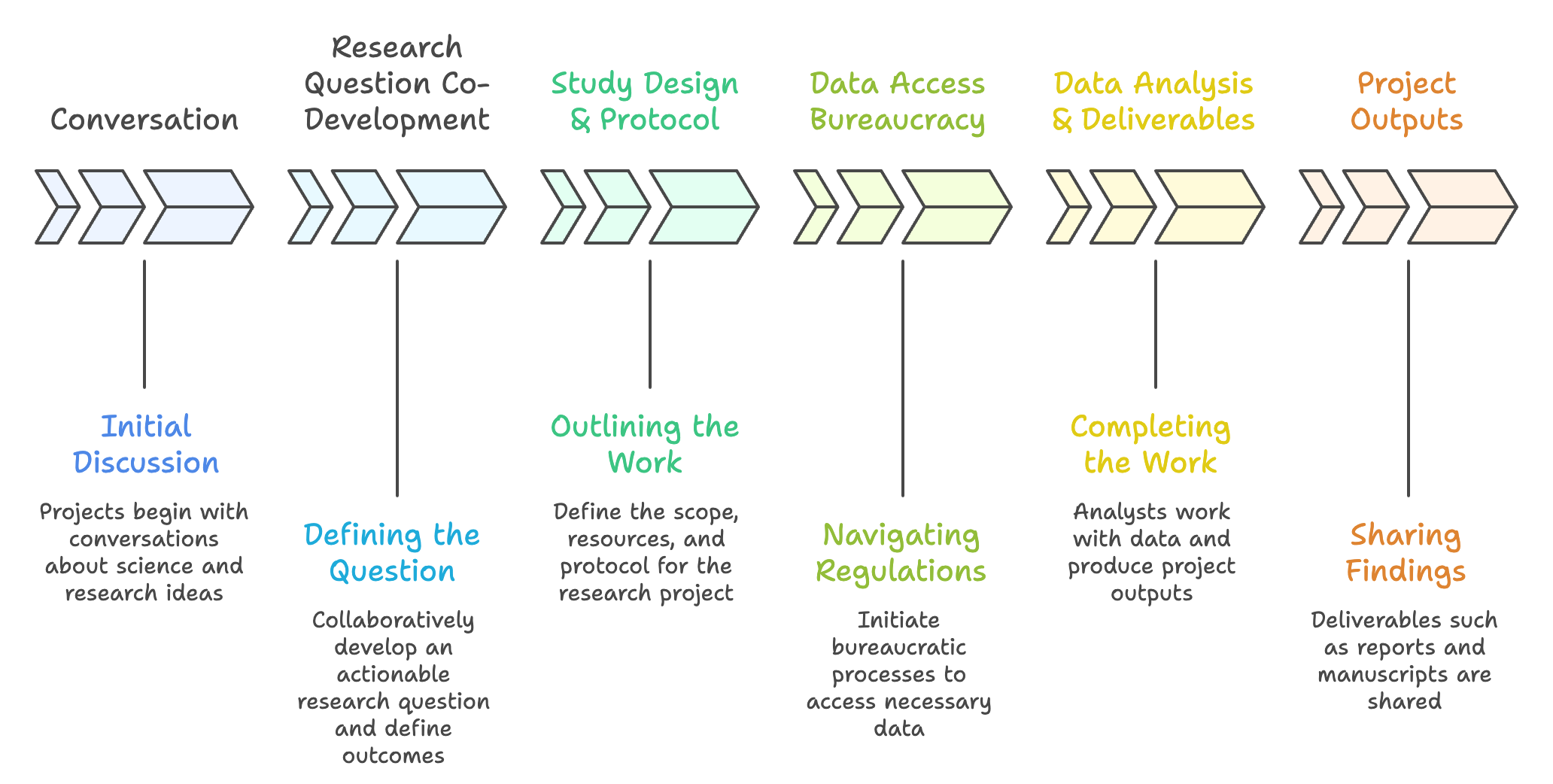
If these conversations lead to a project idea, then the first step is co-development of a research question. This includes defining what is possible to study with the population-level data available in Canada. Working with our partners, we operationalize an actionable research question and define what meaningful evidence and outcomes can help improve health.
Study design and protocol development involves outlining the scope of the work we will do together, and includes defining where resources will come from to engage data and analysts.
Then, we initiate the bureaucratic processes required to access the data to answer the research question.
After that, analysts work with the data and complete deliverables.
Outputs from our projects vary, from reports to peer-reviewed manuscripts.
Outputs from our projects vary, from reports to peer-reviewed manuscripts. The key is that our outputs go to who needs them, either the academic community via publication in a scholarly, peer-reviewed journal, or decisionmakers via reports, presentations, conferences, or other knowledge mobilization activities. Research is only useful if it is used, and it gets used if it answers a question that needs answering. That’s why this collaborative approach is important, it maximizes uptake of work that matters to Canadians by answering important questions in tandem with expert users who can make a difference.
If you have a project that you think fits with our research interests, please contact us.
Examples of past projects
SPROUT is part of CNODES.
- (2026) Trends in Oral Immediate-Release Hydromorphone Dispensing in Canada, 2018–2024
- (2026) Long-Acting Inhalable Drugs for Chronic Obstructive Pulmonary Disease
- (2025) Calcitonin Gene–Related Peptide Inhibitors for Migraine Prophylaxis
- (2024) Use of Oral Fluoroquinolones in Canada: A Drug Utilization Study Update